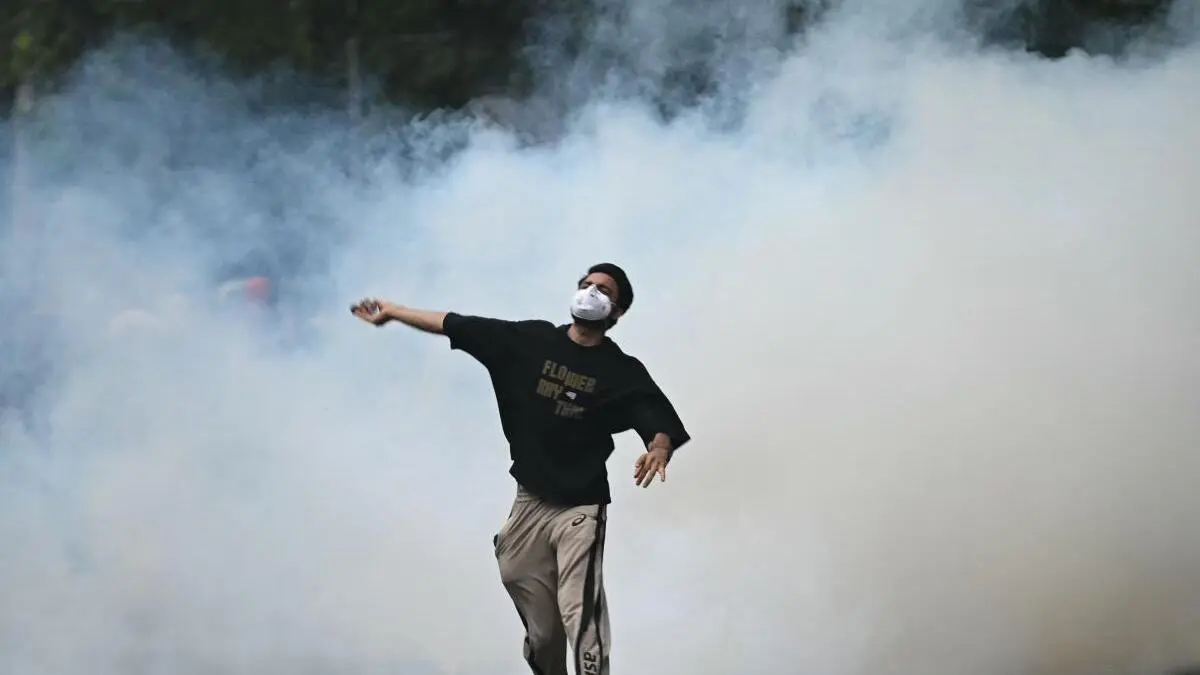
There is a visceral, palpable shift in India’s youth, visible on the streets, across cities, and in digital public squares such as Instagram, YouTube, and X. And the Union government, which has long been wary of public demonstrations, from Shaheen Bagh to the farmers’ protest and now the CJP-led protests, has responded with callousness, disproportionate violence, and short-sightedness.
The greatest irony is not the government’s failure to engage with young Indians who are, at heart, demanding a fair system of education and opportunity. It is that the very apparatus the ruling establishment built—co-opted sections of the news media, a vast social media machine, and control over institutions such as the Delhi Police—is now crumbling along with the government’s own claim to be “pro-youth” and “pro-growth”.
Much has been made of India’s economic potential, in part because it is an enormous consumer market, but chiefly because the case for India’s rise as a global economic power rested on its young population: a working population, skilled and productive, expected to lift healthcare, education and other vital indicators.
As India’s youth take stock of the last decade, the country is the loser. Demographic windows close quickly, and India’s is closing too. Left unaddressed, it risks deepening social inequality, shrinking opportunity for the working-age population, rising household debt, a higher cost of living, and a jobs infrastructure that has failed to materialise.
Against that potential, the last twelve years have been a study in deflection and denial: no jobs crisis, no unemployment, no lack of opportunity—critics wrong, government right—while the country watches another viral clip of the Prime Minister bantering with schoolchildren, on a metro, on a stage.
If the government insists it has served the interests of India’s young, it might answer this: how many times has the Finance Minister raised the jobs crisis in her Budget speech, and how many times has the Education Minister addressed the collapse in his Ministry’s funding? Government data show that the Ministry of Education’s share of the Union Budget fell from 4.6 per cent in 2013-14, the last year of the Congress-led UPA government, to about 2.5 per cent in 2025-26—a near-halving over the Modi government’s tenure, with the Department of School Education’s share cut by more than half and the Department of Higher Education’s share now roughly 60 per cent of what it was twelve years ago.
The cost of neglect
Where is the money for young India going? Who is accountable for building a functioning system of education, examination and skilling for the country’s youth?
The answer, or the absence of one, lies in the last twelve years and in the now-stale promise of a demographic dividend India has long been told it will reap.
An education system that produces graduates with little prospect of employment, examinations that leak with numbing regularity, and a citizenry treated as though it does not count: nearly 2.28 million candidates sat the medical entrance exam, NEET-UG, on May 3 this year. It was cancelled days later after reports that the paper had leaked, and a re-test was held weeks after that. More than a dozen students have since died by suicide, according to reports at the time of writing—the toll has continued to rise and needs to be confirmed against the latest count.
How many of those who run the country have sent their own children through India’s public education system, or encouraged them to sit for an exam like NEET?
Perhaps that question is not worth asking of a government that has, over a decade, deepened economic stress for the country’s most vulnerable—first through demonetisation, then through the steady erosion of social welfare mechanisms.
The violent force used against young students by the police and other armed personnel is shameful in itself. More shameful still, and a deeper betrayal, is the mockery being made of India’s people and their children, who have been failed again and again by systems and institutions that seem designed to wear them down.
The images of young people being caned will haunt India’s economic prospects for years to come. What the world now sees is not only a government known for stoking religious hatred. It is also a government willing to beat its own students senseless at what was, from the outset, a peaceful protest and sit-in.
There is a famous anecdote about Nicaragua’s former dictator, Anastasio Somoza. Accused of rigging an election, he is said to have replied to an electoral opponent: “You won the elections, but I won the count.” The Modi government knows its way around elections. Public protests are different. However hard it tries, it cannot make the truth disappear. For India’s youth, enough is now enough.
Mitali Mukherjee is Director of the Journalist Programmes at the Reuters Institute for the Study of Journalism, University of Oxford.
Also Read | The cockroaches and the strongman
Also Read | Delhi Police crackdown turns CJP protest into a national challenge for Modi