Last Updated:
Today’s race for government jobs reflects a growing belief among young Indians that certainty has become more valuable than ambition in an increasingly unpredictable labour market




The Covid-19 pandemic reinforced this preference for stability. While many private-sector employees faced layoffs, salary cuts and hiring freezes, government employees continued to receive regular salaries and benefits.
India produces roughly 8-9 million graduates every year, but jobs have not kept pace. Nearly 22.7% of them are unemployed. But one statistic continues to define the aspirations of millions of young Indians: government jobs.
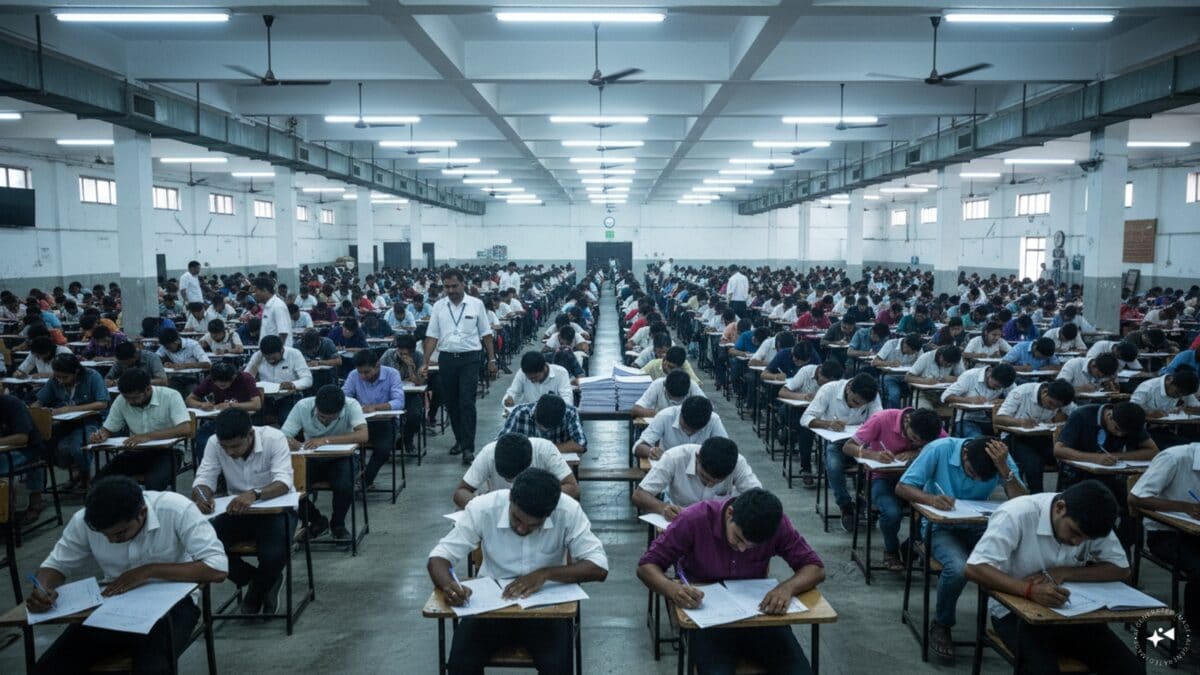
Recruitment exams for a few thousand vacancies attract millions of applicants, with selection rates often lower than those of the world’s most selective universities. According to data, nearly 13.4 lakh candidates applied for the UPSC Civil Examinations in 2024, and only 14,627 made it to the mains stage. Nearly 2,845 reached the interview round, and only 1,000 got the job. That’s the success rate of 0.08%, if you count everyone who applied.
Today’s race for government employment reflects a growing belief among young Indians that certainty has become more valuable than ambition in an increasingly unpredictable labour market.
The Rise Of India’s ‘Security Economy’
Government jobs symbolised prestige, authority and a guaranteed pension. Today, their biggest attraction is stability.
With India’s labour market becoming increasingly uncertain, gig economy expanding, private companies restructuring more frequently, and changing technology, career choices are mostly driven by risk rather than reward. A government job now represents something many private-sector careers cannot always promise: predictable income, employment continuity, healthcare benefits, retirement security and insulation from sudden layoffs.
In effect, India has entered what could be described as a “security economy”, where young people are prioritising stability over rapid wealth creation.
The Covid-19 pandemic reinforced this preference for stability. While many private-sector employees faced layoffs, salary cuts and hiring freezes, government employees continued to receive regular salaries and benefits. For a generation that witnessed widespread economic uncertainty during the pandemic, the appeal of a secure government job has only grown stronger.
In India, government employment also carries significant social value. An IAS officer, a bank employee or even a railway clerk often commands a level of respect in the community that many higher-paid private-sector professionals do not. The perception of stability also influences social status and even marriage prospects in many parts of the country.
Although entry-level salaries in the private sector can be higher, the long-term value of a government job often tells a different story. Pension benefits, medical coverage, housing allowances, regular pay revisions and guaranteed job security until retirement make public-sector employment financially attractive over an entire career. The relatively predictable working hours and better work-life balance further add to its appeal, particularly at a time when long hours and workplace burnout have become common in many private-sector industries.
Why More Graduates Are Choosing Safety
The State of Working India 2026 report shows nearly 40% of graduates under the age of 25 are unemployed, despite India making significant progress in expanding access to higher education. Even among those aged 25 to 29, unemployment remains close to 20%, highlighting the difficulty educated youth face in finding suitable work.
The report also found that around 1.1 crore of India’s 6.3 crore graduates aged 20-29 were unemployed in 2023, illustrating the widening gap between educational attainment and job creation.
The broader youth unemployment rate now stands at 9.9%, more than three times India’s national average. This disconnect creates an uncomfortable paradox.
Young Indians are becoming better educated than ever before, but the economy is not generating enough stable, graduate-level jobs to absorb them.
Government recruitment therefore becomes more than a career option — it becomes an insurance policy. In 2024, roughly 30 lakh candidates competed for about 17,700 government posts; about 170 candidates for every vacancy.
“As the stress tolerance reduces, focus shifts to avoidance and survival than facing challenges and growing. With everything happening at the tap of a screen and at lightning speed, the human nervous system has lost the ability to wait and be patient. The 24X7 doomscrolling keeps raising alerts in the nervous system, creating a perpetual fight-or-flight response. The same thing that has reduced stress tolerance also makes it easy to escape into the virtual world one carries in one’s pocket,” says psychologist Dr Jyoti Kapoor, senior psychiatrist, and founder and director, Manasthali Mental Health & Wellness Services, Gurugram.
How Has AI Changed Hiring And Productivity?
The appeal of secure employment has grown stronger because of changes taking place across the private economy.
AI is beginning to automate routine knowledge work. Global technology firms and consulting companies have announced repeated rounds of layoffs over the past two years. There were roughly 15,000 technology professionals who have lost their jobs through “silent layoffs” in May and projected total job losses of 25,000-35,000 for the full year, according to an Economic Times report.
Hiring has slowed across several white-collar industries. Even professionals with years of experience increasingly speak about job insecurity. According to TeamLease, while 2025 was primarily about corrective excessive hiring during the pandemic, the current year is centred on reshaping workforce structures.
“For many Indians, the primary purpose of education is to secure a job that offers financial security, with professional satisfaction or personal interests often taking a back seat. The private sector is becoming increasingly demanding while AI is rapidly changing the nature of work. Even though private jobs may pay well, employees are judged by productivity, and AI is increasingly competing with the human workforce. On the other hand, government jobs continue to be seen as safe because the system changes slowly and offers stable, long-term employment,” says Dr Kapoor.
How Old And New Generation Viewed Jobs
Previous generations often viewed entrepreneurship or private-sector employment as opportunities for faster career growth and higher earnings. Today’s graduates are increasingly balancing those opportunities against uncertainty.
The recent nationwide protests over recruitment delays, examination paper leaks and cancelled recruitment drives reflected this anxiety. What began as anger over individual examinations quickly evolved into broader frustration about delayed careers, shrinking opportunities and an uncertain future. The protests ultimately prompted examination reforms and other government interventions, but they also exposed how deeply employment insecurity now shapes the aspirations of young Indians.
For many aspirants, clearing a government examination is no longer simply about prestige. It is about reducing uncertainty.
Years spent preparing for competitive examinations are increasingly viewed as an investment in long-term stability rather than a gamble for status.
Can Public Sector Jobs Affect Innovation?
If a growing share of educated youth prefers predictable public sector careers, it could gradually affect innovation, business formation and productivity growth.
Research suggests that people are often at their most innovative and entrepreneurial between the ages of 25 and 35, when creativity, energy and the ability to take calculated risks tend to peak.
In India, however, many talented young people spend these crucial years preparing for highly competitive government examinations such as the UPSC. Aspirants often devote two to five years to preparation and make multiple attempts, despite success rates remaining below 1%. For most candidates, those years do not lead to a government job, leaving a significant pool of talent underutilised during some of their most productive years.
The hesitation to take risks extends beyond career choices. According to the Global Entrepreneurship Monitor (GEM), nearly half of India’s aspiring entrepreneurs say the fear of failure prevents them from starting a business — higher than the global average.
That does not diminish the importance of government employment. India needs an efficient public sector to deliver essential services. The challenge is ensuring that private employment inspires the same confidence.
That requires creating more formal jobs, improving job quality, expanding social security, strengthening labour protections and ensuring graduates have clearer pathways from classrooms to careers.
Ultimately, the extraordinary competition for government jobs is not simply a story about recruitment. It reflects how India’s youngest generation increasingly sees the future.
About the Author

Shilpy Bisht is a News Editor at News18, where she leads the English app operations. She writes on world affairs, health, AI, career, business, and issues affecting women and children. A former print …Read More
August 03, 2026, 15:39 IST

Stay Ahead, Read Faster
Scan the QR code to download the News18 app and enjoy a seamless news experience anytime, anywhere.

login