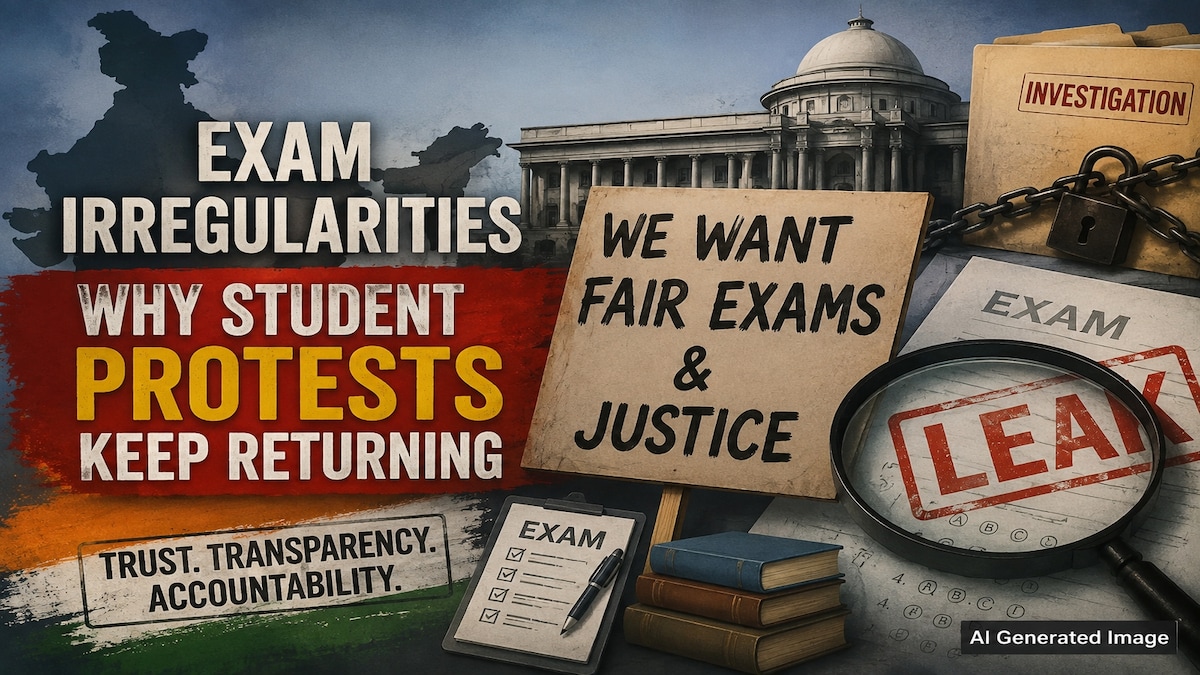
In Jharkhand, demonstrations over alleged irregularities in examinations conducted by the Jharkhand Public Service Commission (JPSC) have continued for more than two weeks. The protests intensified this week, with clashes between police and ABVP workers as protesters marched towards the state Assembly.
The agitation has also acquired a political dimension. The BJP has backed the students, while Congress leader Rahul Gandhi has condemned the police action. The state government, meanwhile, says it has accepted 98% of the students’ demands, including cancelling three examinations and accepting the resignation of three JPSC members.
Yet the protests have continued. Students are demanding a CBI probe into examinations linked to the JPSC and cancellation of the Jharkhand Staff Selection Commission Combined Graduate Level Examination result.
The immediate dispute is over examinations. But the larger issue is much broader: why do allegations of irregularities in competitive examinations repeatedly trigger such intense student anger?
According to former IPS officer Yashovardhan Azad and educationist Vinod Sharma, the Jharkhand agitation points to deeper problems in India’s education, employment and recruitment ecosystem.
Why are exam irregularities such a big issue?
Competitive examinations for government jobs are high-stakes tests. For many aspirants, clearing one examination can determine their career, income and financial security.
Students can spend years preparing, often paying for coaching and study materials and postponing other career choices. This means that when an examination is cancelled, its result is challenged or allegations of malpractice emerge, the consequences can go far beyond losing one examination attempt.
Sharma said the basic aspiration of students is straightforward.
“What do the students need? What do they want? They want jobs. They want earnings. They want stability. They want success,” Sharma said in an interview with CNBC-TV18.
The problem, therefore, is not simply whether a question paper was leaked or whether a particular examination was conducted properly. It is whether students believe that the recruitment system gives them a fair opportunity after years of preparation.
That is why allegations of paper leaks, manipulation or other irregularities can quickly become protests over trust in the entire examination system.
Why do these disputes become so difficult to resolve?
State public service commissions and other recruitment bodies conduct examinations for thousands of government positions. These examinations involve multiple stages, including notification of vacancies, applications, testing, evaluation, publication of results and, in many cases, interviews or document verification.
An allegation of malpractice at any stage can disrupt the entire recruitment cycle.
Cancelling an examination may protect the integrity of the process, but it also creates another problem: thousands of candidates have to prepare and appear again. Those who believe they performed well may object to losing their results, while others may argue that allowing a disputed examination to stand would be unfair.
This creates a difficult balance for governments and recruitment bodies. They have to protect the integrity of the examination while also limiting the disruption to genuine candidates.
The longer a dispute continues, the greater the frustration among aspirants.
Is politics overshadowing the students’ concerns?
The Jharkhand protests have quickly become politically contested, much like several student agitations in the past.
The government has faced accusations of mishandling the protests, while opposition parties have backed the demonstrators. But Sharma and Azad argue that the underlying student concerns should not simply be reduced to political affiliations.
Azad described the current protests as “sans ideology, sans politics” and said they had identified a fundamental problem with governance.
“I think this kind of protest has really shaken the roots of the government and governance because they have pointed out the exact malady,” Azad said.
Political parties may participate in or seek to benefit from a protest, but that does not necessarily mean the original grievance is political.
For governments, the challenge is to separate the political contest around a protest from the underlying question of whether students have legitimate concerns about the recruitment process.
What does the police response have to do with the issue?
The use of force has become another major point of contention in Jharkhand.
Police used water cannons, tear gas and lathi charges as protesters attempted to move towards the Assembly. Students have alleged excessive force, while authorities have argued that police were responding to a crowd that had broken through barricades.
Azad, who served in the police, said it was difficult to determine from a distance whether the force used was excessive. He noted that injuries had been reported on both sides.
However, he also acknowledged that police action can become disproportionate during tense crowd-control situations.
“The question is, the policeman cannot act in an indisciplined manner because he has to work under the law,” Azad said.
His broader point was that the police have to manage crowds within the law rather than treat protesters as enemies.
That matters because a dispute that begins with an examination can quickly become a confrontation over governance. If students believe their grievances are being met with force rather than dialogue, distrust can deepen.
Is this only a paper-leak problem?
Sharma’s argument goes further. He described paper leaks and examination irregularities as symptoms of a much larger problem.
“This is a tree of problems, and there are many branches we can see as a problem, and paper leaks are one of the problems, one of the symptoms,” he said.
One part of the problem is the enormous competition for government jobs.
Government employment continues to be seen by many young people as a source of stability, predictable income and social security. That makes recruitment examinations particularly important. When the number of aspirants is far greater than the number of available positions, even a small number of irregularities can have a disproportionate impact.
The result is an ecosystem built around competitive examinations, including coaching centres, test-preparation material and years of specialised preparation.
Sharma also criticised what he called the “coaching mafia”, arguing that some institutions have moved beyond teaching and preparation towards promises of guaranteed success.
The issue, therefore, is not only how securely an examination is conducted. It is also why so many young people feel compelled to compete for a limited pool of government jobs in the first place.
What happens if students have more career options?
This is where the examination controversy connects to the wider education system.
Sharma argued that students should be prepared for a broader range of career opportunities instead of being pushed towards a narrow set of competitive examinations.
He identified four broad pathways: government jobs, private employment, business and self-employment.
The education system, he argued, should equip students to pursue all four.
The logic is straightforward. If students have credible alternatives, the outcome of one competitive examination does not carry the same weight over their entire future.
This does not eliminate the need for secure and transparent examinations. It reduces the pressure placed on those examinations.
The quality of education is another part of the equation. Sharma argued that teachers need to be capable of making learning meaningful and helping students identify suitable career paths.
In that sense, examination reform and education reform cannot be treated as completely separate issues.
Does the recruitment system need institutional reform?
The Jharkhand dispute also raises a more immediate governance question: how should recruitment bodies respond when allegations of irregularities emerge?
A credible system needs clear procedures for conducting examinations, securing question papers, investigating complaints, protecting evidence and communicating decisions to candidates.
It also needs accountability when irregularities are established.
For students, the issue is not simply whether an investigation is announced. They also want confidence that the investigation is independent, that those responsible will be held accountable and that genuine candidates will not be penalised for failures in the system.
The Jharkhand government has offered a high-level judicial inquiry committee headed by a retired judge. Students, however, continue to demand a CBI investigation and cancellation of the JSSC CGL result.
The difference between these positions illustrates the central problem: trust.
Even a formally legitimate investigation may fail to calm a protest if students do not believe that the process is sufficiently independent or transparent.
Should education be taken out of bureaucratic control?
This is where Azad and Sharma’s arguments converge most clearly.
Azad argued that education needs to be placed more firmly in the hands of educationists rather than being controlled primarily by bureaucrats.
“Time has come to take education out of the grip of the bureaucrats and give it back to the educationists, who are the right persons to handle this,” he said.
The argument is broader than the Jharkhand controversy.
Examination reform requires better administrative systems, stronger security, credible investigations and transparent communication. But those measures alone cannot address the deeper pressure created by an education system in which millions of young people compete for a relatively small number of secure jobs.
The recruitment system and the education-to-employment pipeline therefore need to be looked at together.
Could similar protests emerge elsewhere?
Azad believes the concerns seen in Jharkhand could become part of a wider trend.
He pointed to the condition of state public service commissions across the country and warned that student anger could spread if governments fail to address concerns around recruitment examinations.
“Mind you, this agitation of Gen Z is going to pick up in all the states. They better be aware that this thing is coming,” Azad said.
Whether that prediction materialises remains to be seen. But the warning highlights why the Jharkhand agitation matters beyond the immediate dispute.
The combination of intense competition, dependence on government recruitment, allegations of examination irregularities and distrust of institutions creates conditions in which a single examination controversy can quickly become a much larger movement.
What is the larger lesson from Jharkhand?
The immediate Jharkhand dispute may eventually be settled through an investigation, judicial process or fresh examinations.
But simply cancelling an examination or ordering an inquiry may not be enough to restore confidence.
The deeper challenge is to build a recruitment system in which students believe that examinations are secure, investigations are independent, decisions are transparent and genuine candidates will not lose years of preparation because of administrative failures.
At the same time, India’s education system needs to provide young people with credible pathways beyond a narrow race for government employment.
That is why the Jharkhand protests are about more than paper leaks.
They raise a larger question about the relationship between education, employment, governance and trust: can India’s examination and education systems give young people confidence that merit, preparation and hard work will actually determine their chances of success?
That question extends well beyond Jharkhand.