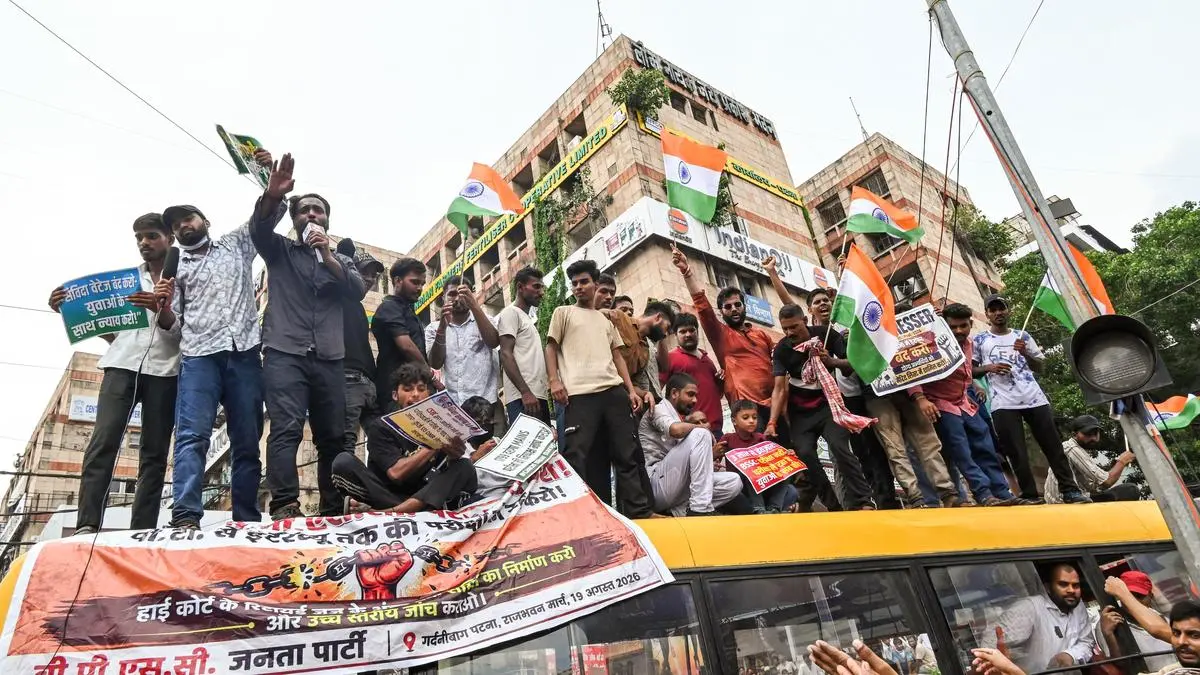
On August 25, when student protests in Patna turned violent—from dancing, bathing, and shampooing in front of water cannons to breaking barricades and pelting stones—the episode set off a political storm. But the causes run deeper.
This is not the first student protest Bihar has seen in recent years. Its significance lies in timing: it follows the CJP-led protest against NEET-UG paper leaks at Jantar Mantar in New Delhi in June-July, and the protest over irregularities in the Jharkhand Public Service Commission examination in Ranchi in July-August. In Bihar, the protesters are aspirants of the Bihar Public Service Commission, who allege that the exam was compromised by a paper leak and are demanding it be cancelled.
The protests began when prelims exams were conducted and continue to date even after the completion of exams in June. The other protesters, who demanded that the proposed two-phased format of the Teacher Recruitment Examination-4 should be changed to a single phase, also joined. They are alleging irregularties in all recruitment exams.
In all three protests, the underlying fear is the loss of job opportunities. In the two protests in the undivided Bihar region—Jharkhand was part of Bihar until 2000—the fear is more specific: losing a government job, of which there are already too few. With private-sector jobs scarce and few avenues to build entrepreneurial skills in the two Hindi-belt States, a government job remains the dream.
Santosh Mehrotra, a former professor of economics at the Centre for Labour, Jawaharlal Nehru University, and co-author of the recent book India Out of Work: Rethinking India’s Growth Story, says protests over paper leaks and government appointments are nothing new.
“Since the BJP came to power in India, if there have been 152 such paper leaks, should protests be surprising? The Bihar government of [then] Chief Minister Nitish Kumar, in power for 20 years, mostly with BJP support, did not make many appointments of teachers or health staff for two decades. Vacancies run into lakhs. Recent teacher appointments are, for the second time in three years, causing aspirants to return to the streets—over the recruitment exam’s design and over whether only Bihari domiciles should be considered,” he told Frontline.
On the economic causes, Mehrotra says Bihar’s per capita income, as a share of India’s, has not risen above one-third in 20 years—a result, he argues, of the government’s neglect of investment in human capital. “India has 100 million youth who are not in education, employment, or training—they have stopped looking for work. This is in addition to the nearly 30 million unemployed. The Bihar-Jharkhand failures to make government appointments are a continuation of the Jantar Mantar protest, and they remain unstoppable. Double-engine ki Sarkar [double-engine government] has run out of ideas,” he said.
In his book, Mehrotra argues that manufacturing employment fell over the past decade even as farm employment grew. “Private-sector jobs did not grow as fast as demand for work. The number of unemployed tripled, and the number of youth outside education and employment doubled between 2012 and 2024, to 100 million. This is why youth are legitimately angry on the streets.” He predicts the anger will not subside soon. “Had alternative policies been followed, youth frustration might never have exploded the way it now has,” he said.
Bihar’s position is precarious in another sense: major industries and mineral resources moved to Jharkhand after the 2000 bifurcation. So when students felt that the narrow window of government jobs still open to them was being compromised by fraud and irregularities, they were unwilling to accept it.
Nothing else explains the desperation with which protesting students in Patna—met by water cannons the police have often used to disperse crowds—responded by dancing in the spray rather than retreating. It was an unusual response to an unusual situation.
Political Reactions
After the police baton-charged protesters, Leader of the Opposition Rahul Gandhi wrote on X that the “students of Bihar have a very straightforward question—why the irregularities in recruitment exams? Why no action on allegations of paper leaks? And how long will this tampering with the future of the youth continue?” Gandhi said the BPSC controversy was not new—students have protested for months over the recruitment process, exam pattern, delays, and transparency—and that instead of answering, the government was “wielding batons and water cannons, and taking students into custody.” Attacking the BJP-led NDA government in the State, Gandhi said it should understand that “questions don’t stop with batons.”
Rashtriya Janata Dal leader and Leader of the Opposition in the Bihar Assembly, Tejashwi Yadav, met the injured students on August 26. He accused the BJP of trampling “the future of students and youth” in “the country’s youngest State with the highest youth population,” and said protesters “raising their voices for their rights are being showered with AK-47 bullets and lathis.” He called on Chief Minister Samrat Choudhary to apologise for the police action.

RJD supporters carry rifle cutouts protesting State government policies and a recent shooting incident in Siwan, in Patna, on August 19.
| Photo Credit:
PTI
Yadav also wrote to Choudhary urging dialogue with the protesters. Congress leader Sushil Kumar demanded a single-stage examination for the Teacher Recruitment Examination (TRE) 4.0, with negative marking abolished, adding: “There are numerous other issues as well—regarding the BPSC, the BSSC, Sub-Inspector recruitment—the government has offered no assurances on any of these points.”
A recurring grievance
Politics apart, the protest reflects a deep-seated anxiety among young people about unemployment—an issue that resurfaces in Bihar again and again. In December 2024 and January 2025, student protests over the 70th BPSC examination kept Patna in the headlines for weeks. It began after an exam held on December 13, 2024, when students at Patna’s Bapu Pariksha Parisar alleged that question papers had been leaked and paper distribution was unfair. FIRs were lodged against several students, and the BPSC ordered a retest at the Patna centre.

Students hold placards protesting alleged paper leaks, exam irregularities, and unemployment surrounding the 70th BPSC examination, in Patna, on August 25.
| Photo Credit:
Rahul Sharma/ANI
In 2022, when protests over the Agnipath scheme—the short-term recruitment scheme for the armed forces—spread across the country, Bihar saw some of the most severe unrest: protesting students set fire to the Bhagalpur–New Delhi Vikramshila Express and the Jammu Tawi–Guwahati Amarnath Express in Lakhisarai and Samastipur districts, and burned a railway station in Bhojpur district.
Bihar’s unemployment rate has consistently exceeded the national average: 3.9 per cent against 3.2 per cent nationally, as of 2022-23. Nearly 34 per cent of the State’s population is multidimensionally poor, according to the National Multidimensional Poverty Index. The attachment to government jobs runs deep enough that in the 2025 Bihar Assembly election, both then Chief Minister Nitish Kumar and then Leader of the Opposition Tejashwi Yadav claimed credit for providing teaching jobs to the State’s youth. The current protests should be read against this backdrop.
Senior RJD leader and Rajya Sabha MP Manoj Kumar Jha says young people are right to be angry over paper leaks and technical failures that undermine the fairness of recruitment examinations. “The young are experiencing a deep sense of disillusionment, driven by an economic reality in which higher educational attainment no longer guarantees dignified and secure employment. At its core, the current protests represent a demand for administrative transparency, institutional accountability, and the timely, secure processing of government employment opportunities. These are concerning issues that need to be dealt with urgently,” Jha told Frontline.
The government, Jha said, could fix these problems if it had the political will. “Think of it this way: if recruitment and exams—which are actually routine matters—cannot be conducted reliably by the government, then what expectations can we have from it on more complex developmental challenges?” he asked.
Also Read | Bharat, Bhagat, Bihar
Also Read | Dharmendra Pradhan’s resignation: Why the Modi government backed down