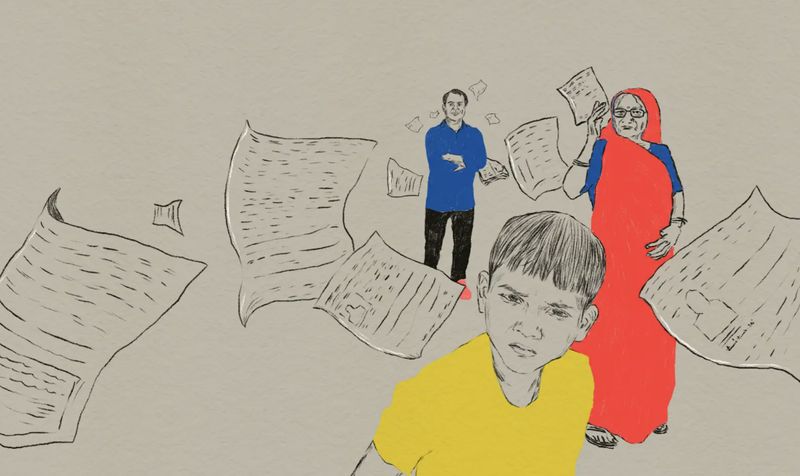
This new disclosure requirement has raised questions about the government’s motivation to seek this information.
Jaipur: The Bharatiya Janata Party (BJP) government in Rajasthan has introduced a new disclosure requirement on its State Recruitment Portal, requiring applicants applying for government jobs to state whether they have “settled in India from another country”. If an applicant answers “Yes”, they must specify the country of origin from a limited list that includes Pakistan, Tibet, Burma (now Myanmar), Sri Lanka and certain African countries.
The requirement is being sought even from applicants who declare their nationality as Indian, their home state as Rajasthan and their home district as a district within Rajasthan. This means that applicants identifying as Indian citizens are still required to disclose whether they had migrated to India from another country. Previously, applicants were required to only specify their nationality, home state and home district under the “domicile details” category of the application forms.
This raises constitutional concerns on whether the information collected through the recruitment portal is used to distinguish between Indian citizens on the basis of their country of origin while considering them for public employment. Article 16 of the Constitution guarantees equality of opportunity in matters of public employment, and any differential treatment would be violative of this fundamental right.
Speaking to The Wire, Dr. Saroj Khan, secretary of the Centre for Human Rights and Social Welfare, a Jaipur-based organisation working on minority rights, justice and education, pointed out that the disclosure requirement could have serious implications for Rohingya Muslims from Myanmar who were born and brought up in India, studied here, obtained valid residential and identity documents, and are now qualified to apply for government jobs.
“Clearly, the government is treating public employment as a national security issue because it knows that applicants may now include people who have settled in India from other countries, such as the Rohingya. Even today, despite possessing valid documents, they are subjected to police crackdowns at any time,” Khan said.
The list of countries provided on the recruitment portal is equally puzzling. It is neither confined to India’s geographical neighbours nor based on any apparent legal classification, as it includes several African countries, with some that no longer exist. The list mentions countries like Burma (now Myanmar), Ethiopia (incorrectly spelt as Ethiopia in the list), Kenya, Malawi (incorrectly Malwai in the list), Pakistan, Sri Lanka, Tanganyika and Zanzibar (which merged to form the United Republic of Tanzania in 1964 and no longer exist as separate countries), Tibet, United Republic of Tanzania, Uganda, Zambia and Zaire (now the Democratic Republic of Congo).
At the same time, it omits some of India’s neighbouring countries, such as Bangladesh and Afghanistan, while listing Pakistan, Sri Lanka and Burma. Why the state is only offering these limited options is not explained.
Former Rajasthan Public Service Commission (RPSC) member Vinod Sharma told The Wire that, in his view, the disclosure requirement is specifically targeted at Hindu and Muslim migrants from Pakistan who have acquired Indian citizenship.
Rajasthan shares a long border with Pakistan, with frontier districts such as Jaisalmer, Bikaner, Barmer and Sri Ganganagar. These districts have witnessed the settlement of Pakistani Muslims over several decades. Many among them have since acquired Indian citizenship through registration or naturalisation and have integrated into local communities. Still, government and security agencies argue that their presence is changing the demographics of the State, although the extent of any demographic impact remains contested and has not been officially quantified. News reports consistently flag the state’s demolition of ‘illegal’ mosques in Rajasthan’s Pakistan-bordering districts, often justified on the ground of national security.
Consider a Hindu person from Pakistan who acquired Indian citizenship under the Citizenship (Amendment) Act, 2019 and later applied for a government job in Rajasthan. Such a person would be required to disclose to the state that they had settled in India from Pakistan. Requiring such citizens to disclose their country of origin for public employment may be seen as subjecting them to an additional layer of scrutiny even after they have lawfully acquired Indian citizenship.
Speaking on condition of anonymity, an official in the Rajasthan department of information technology and communication told The Wire that the department merely operates the recruitment portal and implements directions issued by the concerned authorities. The official said the decision to introduce the disclosure requirement was taken by the competent authorities including the RPSC, not the department.
The Wire also sent a message to the RPSC through its Public Relations Officer seeking an explanation for the disclosure requirement. However, no response had been received by the time of publication. BJP chief spokesperson Anil Baluni also declined to comment, saying he was out of the country. Meanwhile, speaking to The Wire, former RPSC member Brahm Singh Gurjar defended the disclosure requirement, saying it was well within national interests and necessary to protect the country from “infiltrators”.
Shruti Jain is an independent journalist and lawyer.
This article went live on July tenth, two thousand twenty six, at thirty minutes past eight in the evening.
The Wire is now on WhatsApp. Follow our channel for sharp analysis and opinions on the latest developments.