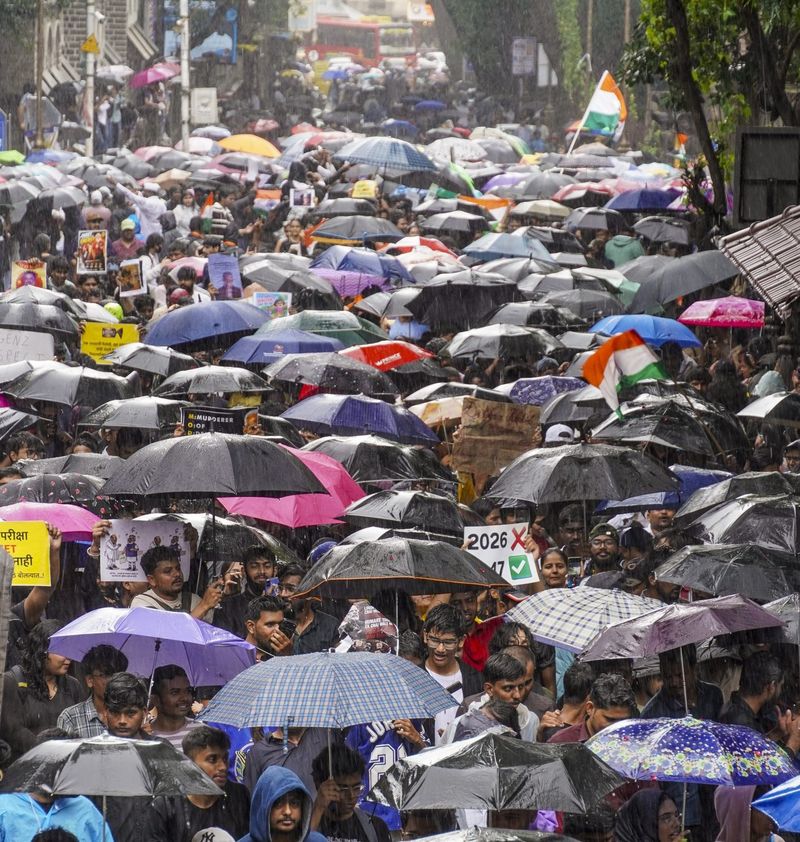
A rote-learning education system is at the root of India’s job crisis, and the scenario is set to worsen with time unless there is an overhaul.
In India, the public discourse on unemployment is largely confined to the clamour for government jobs among highly qualified youth. An important dimension of the crisis has received far less attention: the deep disconnect between what the education system teaches and what employability actually requires.
In most schools, both public and private, education is entirely curriculum-oriented. Students are incentivised to mug up answers likely to appear in examinations, investing considerable effort in memorising notes and guidebooks. Increasingly, many now rely on AI tools for the same purpose. This orientation is compounded by unequal access to the resources that might otherwise offset it.
Institutional reinforcement of the social divide
Most public and non-elite private schools lack basic physical infrastructure such as adequate classrooms, clean drinking water and separate, hygienic washrooms for boys and girls. They often lack decent libraries too, denying students the chance to develop an interest in reading beyond their prescribed textbooks.
Elite private schools, by contrast, offer well-stocked libraries and students who possess social capital. Most of their students grow up in households where reading is encouraged, and some begin reading authors such as Shakespeare or P.G. Wodehouse at an early age. Their peers in public and non-elite private schools, meanwhile, remain confined to textbooks and guidebooks.
This gap is reinforced at the institutional level. Mainstream and social media routinely valorise board-exam toppers, yet rarely hold examining bodies such as the Central Board of Secondary Education (CBSE) and the various state education boards accountable for setting question papers that primarily test memorisation and rote learning. Students are pushed into a rat race to secure the top rank in their batch, and this pressure arrives at a decisive moment: after Class 10, when students must choose a stream with little to no counselling from their schools.
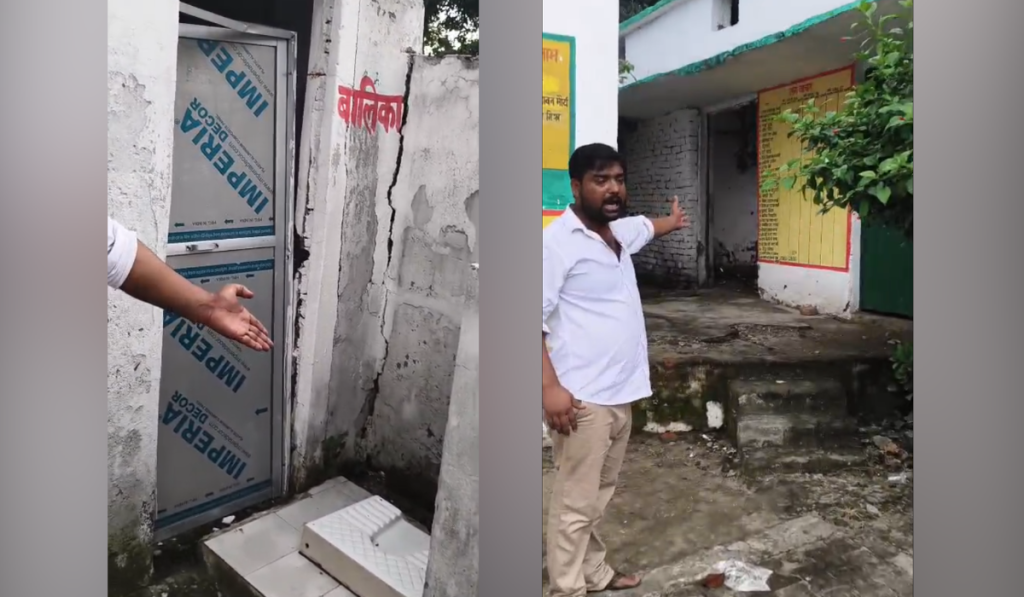
A youth activist, Rajat Singh, shows the dilapidated condition of a government primary school in Deoria, Uttar Pradesh. Photo via his Facebook video.
Not every student can afford a private career-counselling centre, so many simply choose the medical or non-medical stream according to their parents’ wishes, rather than undergoing the personality and career mapping that would ideally guide such a decision. Most parents and students in India remain unaware that such mapping exists at all.
Human cost of the coaching industry
This lack of guidance sets the stage for what follows. Class 11 often feels less like the start of senior school and more like the starting gun of a long, exhausting race towards NEET, JEE, and the promise of a “secure” future. Coaching classes take over schedules, and expectations begin to weigh heavily.
Many parents, driven by concern and hope, come to see success in these exams as the only path forward, while failure is treated as something far more frightening than it should be.
Also read: The Chapters of History the Government Doesn’t Want Students to Read
Beneath this high-pressure environment are students still trying to figure out who they are and what they want. For some, the constant strain, fear of falling short, and relentless comparison become overwhelming; tragically, a few reach a point where the stress feels unbearable and, in the absence of support, see no way out.
Professor and former NCERT Director Krishna Kumar has written pointedly about the coaching industry that has grown up around this pressure, and his critique is worth quoting at length because it names precisely how the system converts anxiety into a business model:
“Kota and other coaching hubs offer a single-minded pursuit of success in competitive exams. By non-stop advertising, the coaching industry creates the impression that everyone can succeed. Parents already believe that all their sons and daughters need is coaching in order to get a high rank in NEET and JEE. The child’s own interests or wishes do not count”
He says that the key difference between “a schoolteacher and a coach” is that the latter’s task is to hone a student’s skill in solving multiple choice questions (MCQs) at breakneck speed. MCQs, he correctly points out, feature more often in school exams, while NEET is entirely MCQ-based and the JEE also uses the format. And MCQs provide no time for reflection or revision, plus come with penalty marking. Only “drill and cramming” can help crack such exams – and the coaching industry enables this.
A generation without basic skills
The consequence is that most students who complete their schooling do not possess even basic soft skills such as communication and writing. Many cannot speak any language fluently or draft a CV appropriately. What, then, is the value of an education system that fails to equip the majority of its students with the most basic skills?
Milind Sohodi, a professor at IIT Delhi, recently described why high school students in India are often found unable to “measure time or length”. Many graduates, he said, cannot even write a first-person account or use a spreadsheet. He said one reason this had happened was because “the intellectual aspirations of Indian youth are being funnelled almost entirely into competitive exams”.
Consider, in light of such expert observations, a thought experiment. A student who has just passed Class 12 is asked to read a book and narrate its summary. He would struggle to do so coherently. Writing a review would be harder still, because he may not have read a book other than his textbooks throughout his school life. This is not a comment on individual ability but on what the system has trained students to do, and not to do, for twelve years in school.
Higher education fails to correct the problem
One might expect higher education to fill this gap. Instead, classroom teaching in the majority of Indian colleges and universities has become obsolete. Students often attend lectures merely to meet the minimum attendance requirement for end-term examinations.
Lectures that should serve as platforms for engagement have largely been reduced to one-way monologues, as teachers, much like their counterparts in schools, remain preoccupied with a single objective: completing the syllabus.
Unsurprisingly, many students are disengaged; they reason that they can just as easily watch lectures on YouTube or rely on tools like ChatGPT while preparing for exams. Barring a few exceptions, Indian higher-education institutions have yet to devise any meaningful policy on the use of AI, suggesting either a lack of awareness or an inability to respond effectively to the issue.
A distorted measure of worth
This chain of failures ends up shaping how Indian society measures a person’s competence. Government-job seekers are often mocked by both laypersons and experts for dedicating years to entrance-exam preparation, while students from elite institutions (the IITs, IIMs, NLUs) who land lucrative jobs at top MNCs or Tier 1 law firms are showered with praise by the media, society, and their alma maters.
Yet a pertinent question arises: do the latter not also fall within the category of job seekers? They too deserve credit for the work they put into their CVs, and in a developing country, a high-paying white-collar job is a genuine route to upward mobility. But the way such individuals are treated as “prodigies” reveals a mindset in which “competence” and “knowledge” are measured by something overly simplistic: the kind of white-collar job a person holds and the salary attached to it, not by the skills the education system actually failed to teach them.
Why ‘just become an entrepreneur’ isn’t an answer
Faced with this dysfunction, the government and various experts have for years peddled a different narrative: that young people should simply become entrepreneurs. But what has actually been done to build an ecosystem of entrepreneurship in schools and colleges? A curriculum this outdated is poorly positioned to produce entrepreneurs, and in any case, start-ups are not a credible solution to unemployment at scale.
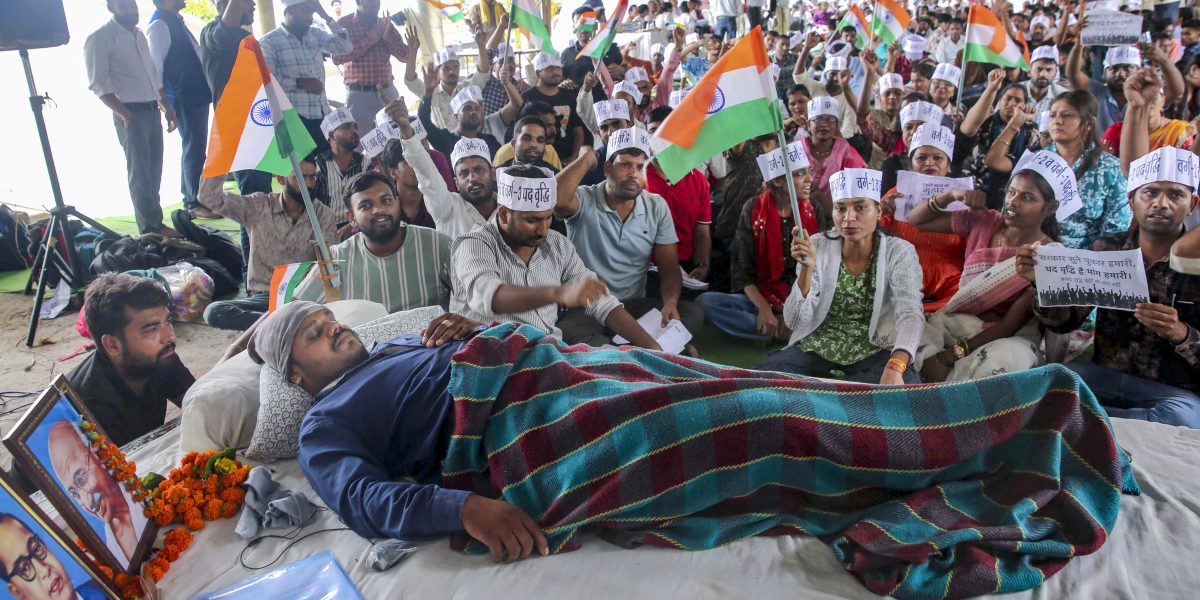
Demonstrators on hunger strike demanding an increase in government positions in the school education department, at Neelam Park, in Bhopal, August 23, 2026. Photo: PTI
Anurag Mehra, an engineering and policy teacher at IIT Bombay also recently wrote about buzzwords like “start-ups” and “entrepreneurship” to point out that encouraging entrepreneurship is not the same as hyping it beyond reason and proportion. “Start-ups are not — and never will be — a solution to the unemployment crisis,” he wrote, until the nature of school education remains what it is.
The politics of an undeliverable promise
The education crisis becomes a political one. When a party promises in its manifesto that it would provide crores of government jobs, it is selling snake oil to the youth. No government, state or even the Union, has the institutional capacity to carry out recruitment at that scale (frequent paper leaks are themselves evidence of this incompetence), nor the funds to pay salaries to such a large cohort.
By making such unrealistic promises, political parties evade their real responsibility: attracting private investment, equipping the youth with relevant skills, and undertaking meaningful reform of the education sector.
Today’s job market expects entrants to possess creativity, critical thinking, and the capacity for innovation. Yet no political party has made a serious effort to revamp an archaic education system so that students might actually acquire these traits. Even the country’s most “prestigious” examination, the UPSC Civil Services exam, has been criticised for testing applicants on little more than memorisation.
Unless the education system undergoes a complete overhaul, it will keep producing government-job seekers, people who spend years preparing for recruitment exams without acquiring skill in the process. As AI increasingly displaces jobs in the private sector, the demand for government jobs is only likely to grow, and the employment scenario in India is set to worsen with time.
Koshik Singh holds a Masters in Law from National Law University, Jodhpur and Rahul is a civil services aspirant.
This article went live on August twenty-seventh, two thousand twenty six, at zero minutes past ten in the morning.
The Wire is now on WhatsApp. Follow our channel for sharp analysis and opinions on the latest developments.