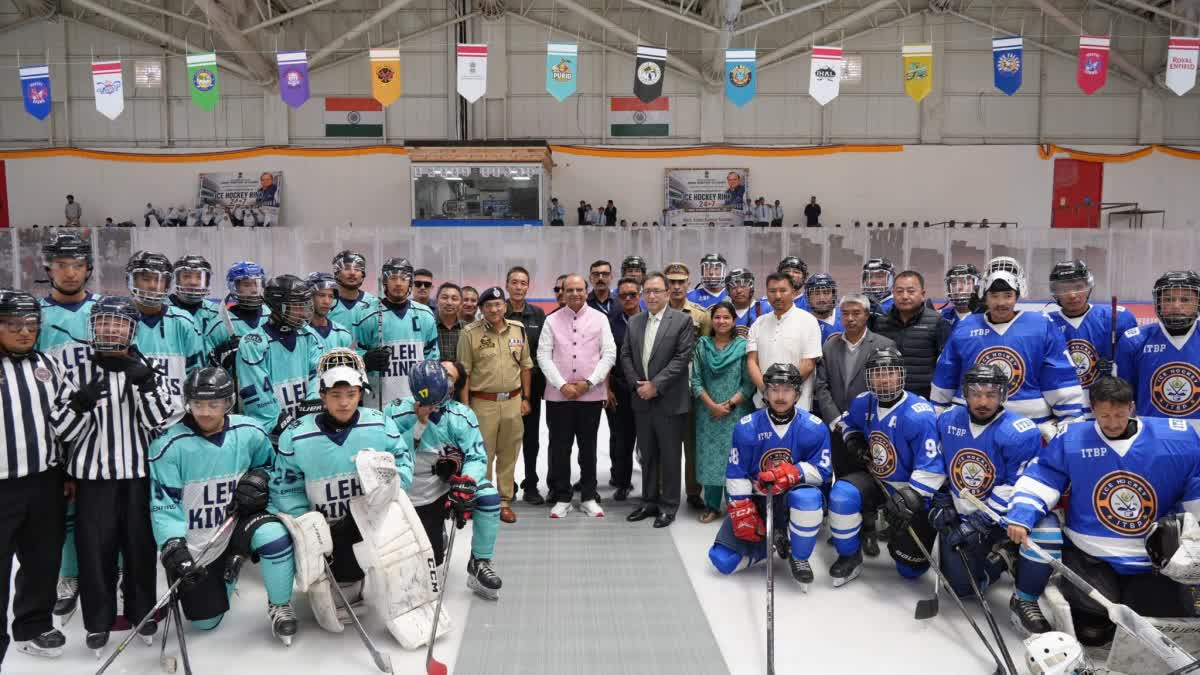

Lieutenant Governor Vinai Kumar Saxena with sportspersons In Ladakh. (Special Arrangement)
Srinagar: Ladakh has introduced a 4% horizontal reservation for outstanding sportspersons in direct recruitment to Group C government posts, marking a major policy shift aimed at encouraging sports as a viable career option in the Union Territory.
The decision, approved by Lieutenant Governor Vinai Kumar Saxena, is part of the newly notified Ladakh Sports Policy, 2026. The reservation applies to non-gazetted Group C posts under the Ladakh administration and will be available to eligible athletes who meet recruitment requirements, including qualifying examinations. Officials say the measure is intended to ensure that talented young people do not abandon sporting careers because of concerns about employment and financial stability.
Proud to announce a historic milestone for our youth!
Ladakh is now the first UT in India to provide a statutory 4% reservation for Outstanding Sportspersons in government jobs for Group ‘C’ Non-Gazetted posts.
Along with assured scholarships, cash incentives, and modern… pic.twitter.com/ZeX49Zjxdp
— LG Ladakh (@lg_ladakh) August 19, 2026
The New Reservation System
The 4% quota has been introduced as a horizontal reservation. Unlike vertical reservations based on social categories such as Scheduled Castes, Scheduled Tribes or Other Backward Classes, a horizontal reservation cuts across all categories.
This means a sportsperson selected under the quota will still be counted within his or her respective social category. The reservation functions in a manner similar to quotas provided for women, persons with disabilities and other special categories.
The policy creates a dedicated pathway for athletes to compete for a fixed share of government jobs while continuing to participate in the general recruitment process.
Announcing the reservation on Wednesday, LG Saxena described it as part of a broader effort to ensure that talented youth do not have to choose between sporting ambitions and financial security.
“The initiative is aimed at ensuring that no talented youth in Ladakh is forced to give up sporting aspirations because of the concerns about financial support or future employment, and that excellence in sports becomes a pathway to both pride and a secure career,” he said.
Ladakh Women’s Ice Hockey Foundation Team (Special Arrangement)
The LG added that the administration was creating an ecosystem where talent would be “recognised, nurtured and rewarded without financial burden on families” through reservation in government jobs, scholarships, cash incentives, infrastructure development, scientific coaching and career opportunities.
Who Qualifies As An Outstanding Sportsperson?
Under the notified rules, eligibility extends to athletes who have represented a state or the country in recognised national and international competitions.
The category includes medal winners in senior and junior national championships, Khelo India Youth Games participants above 18 years of age, medal winners in Khelo India Winter Games, Khelo India Para Games and Khelo India University Games. Athletes who have represented universities in recognised inter-university competitions are also eligible.
The administration has also included eligible chess players in line with provisions followed by the Department of Personnel and Training. To ensure transparency, a Sports Merit List will be prepared based on the highest sporting achievement of each applicant. International medals will carry the highest weightage, followed by achievements at national championships, National Games, university competitions and Khelo India events.
Why Is The Policy Significant For Ladakh?
Ladakh has produced athletes who have competed at national and international levels despite difficult terrain, harsh winters and limited sporting infrastructure. The region has gained recognition for winter sports such as ice hockey, ice skating and skiing, while athletes have also excelled in archery, athletics and martial arts. For many athletes, however, sporting success has not always translated into financial security.
Rinchen Dolma, president of the Ladakh Women’s Ice Hockey Foundation, former captain of the Indian women’s ice hockey team and the first Union Territory awardee in the sports category, described the reservation as an important step.
“I see the 4% reservation as a very positive step for sportspersons in Ladakh. It will give athletes greater confidence and job security, and I believe it can motivate more young people to take sports seriously and pursue it professionally,” she told ETV Bharat. “For athletes, knowing that their hard work can lead to career opportunities is a great encouragement.”
Lieutenant Governor Vinai Kumar Saxena with sportspersons In Ladakh. (Special Arrangement)
Padma Chorol, one of the founding members of India’s first women’s national ice hockey team and assistant captain of the UT Ladakh women’s team, said the announcement felt like long-awaited recognition for athletes.
“It’s really great news, and somehow it feels like a new bloom is finally coming to sports in Ladakh after a very long time,” she said. “We dedicatedly worked hard with passion, but for a long time, we didn’t get the recognition or opportunities that we deserved. Now, I genuinely feel that sports is finally getting some much-needed spotlight.”
How Does Ladakh Compare With The Rest Of India?
Many Indian states provide sports quotas in government jobs, educational institutions and public sector organisations. States such as Haryana, Punjab, Odisha, Rajasthan and Maharashtra have long used employment incentives and reservations to reward sporting achievements.
Haryana, in particular, is known for offering government jobs, cash rewards and promotions to medal-winning athletes. Odisha has created dedicated sports cadres and has invested heavily in sports infrastructure. Several states also reserve seats in educational institutions for sportspersons.
What makes Ladakh’s move notable is the administration’s claim that it is the first Union Territory to provide a fixed and notified 4% reservation for outstanding sportspersons in Group C government posts. The policy establishes a clear framework rather than relying solely on discretionary appointments or incentive schemes.
Can Govt Jobs Help Promote A Sporting Culture?
Experts say employment opportunities can play a major role in encouraging participation in sports, especially in regions where families often prioritise stable careers.
Government jobs offer a predictable income, social security and long-term career prospects. Such incentives can reduce the pressure on athletes to abandon training in favour of immediate employment. For athletes in remote villages, the assurance of a career path may also persuade parents to support children in sports at a competitive level.
Chorol believes the reservation can boost confidence among young athletes. “The 4% horizontal reservation in Group C posts is a very positive step because it can give athletes a sense of security and confidence that their years of hard work and dedication can also lead to a stable career,” she told ETV Bharat.
“This can definitely boost the morale of players and encourage more young people to take sports seriously and pursue it professionally.”
While welcoming the policy, several athletes have also argued that exceptional performers deserve opportunities beyond Group C posts.
Dolma said the administration should consider suitable Group B opportunities for athletes who have represented India at the international level. Chorol also called for greater recognition of athletes who have brought national honours to Ladakh.
What Challenges Lie Ahead?
Athletes and sports administrators agree that employment incentives alone cannot solve the challenges facing sports in Ladakh. The Union Territory’s high-altitude geography, sparse population and long winters create unique obstacles. Many athletes train with limited facilities and must travel long distances for competitions and coaching camps.
Dolma said infrastructure and exposure remain major concerns. “From my experience, limited infrastructure, lack of specialised coaching and regular exposure to high-level competitions remain major challenges for athletes in Ladakh,” she said.
“We also need better sports infrastructure, qualified coaches, proper equipment, regular competitions and financial support.”
“I faced many challenges, especially the lack of proper equipment. We often did not have our own equipment and had to borrow it from the boys’ team, but these difficulties only made me more determined to continue playing and create a place for women in ice hockey,” she said.
Chorol echoed similar concerns and pointed to the need for sports science support, training facilities and competitive opportunities. “Employment incentives alone cannot create a sustainable sporting ecosystem,” she said. “We also need better sporting infrastructure, qualified coaches, regular competitions, access to proper training and equipment, sports science and fitness support, and more opportunities for athletes to compete at national and international levels.”
The development in Ladakh comes against the backdrop of order on Jammu and Kashmir’s sports quota framework. The order provides a legal mechanism for the appointment of outstanding sportspersons in government service and lays down eligibility conditions, recognised disciplines, assessment criteria and selection procedures. The J&K Sports Council has repeatedly maintained that appointments under the sports quota are governed by statutory rules and are made through a merit-based process.
However despite the policy, some sportspersons have questioned the pace of recruitment, the interpretation of eligibility criteria and the weightage assigned to different achievements.
Also Read
- Unfinished Sports Infrastructure And Limited Recruitment In Jammu Kashmir, Reveals RTI Data
- National Sports Awards 2025: No Khel Ratna Recommendation; 17 Names Get Arjuna Awards