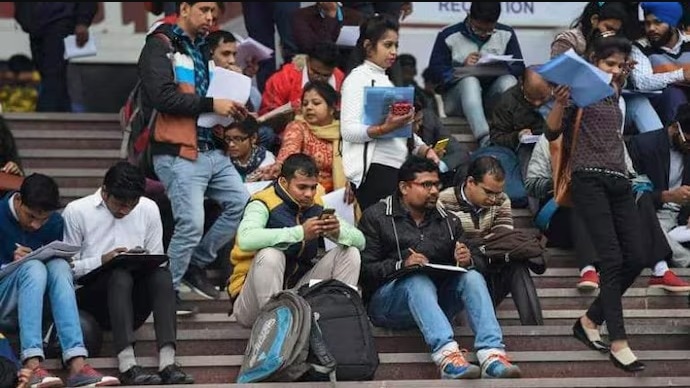
For young Indians, the employment problem may be less about finding the perfect job and more about finding a job at all.
As many as 32% of respondents in the latest India Today Mood of the Nation survey said not having enough jobs is the biggest employment problem facing young Indians. Another 18% pointed to low salaries, while 17% said jobs do not match qualifications. An equal 17% said government recruitment is too slow or unreliable.
The survey also reveals who young Indians believe should be responsible for fixing the problem. A clear 63% said the Union and state governments should bear the main responsibility for improving employability among young people. Schools and universities came a distant second at 14%, followed by private employers at 9% and individuals and families at 5%.
The findings come at a time when India is trying to turn its huge young population into an economic advantage. Recent employment data and major reports, however, show why the transition from education to a stable job remains difficult.
The Mood of the Nation is a bi-annual survey that’s been commissioned by the India Today Group for around two decades now. The August 2026 edition was conducted by CVoter with a sample of 25,184 people directly surveyed between July 1 and August 25. Another set of 91,795 interviews conducted over the last six months as part of CVoter’s regular tracking were also used to formulate the findings of the August Mood of the Nation 2026.
NOT ENOUGH JOBS TOPS THE LIST
The first finding is striking because it puts the basic availability of jobs ahead of other concerns.
While 18% said salaries are too low, and 17% each identified qualification-job mismatch and slow or unreliable government recruitment, the largest group, 32%, chose simply “not enough jobs”.
Another 7% said education does not provide the skills employers need, while 4% pointed to too few secure jobs with benefits. Five per cent said they did not know or chose not to respond.
The numbers suggest that the youth employment debate is not only about employability or skills. For a substantial section of respondents, the more fundamental question is whether enough opportunities exist in the first place.
That concern finds support in the latest State of Working India 2026 report by Azim Premji University which uses the government’s Periodic Labour Force Survey (PLFS).
INDIA HAS MORE EDUCATED YOUTH, BUT THE JOB TRANSITION IS STILL HARD
India has around 367 million people aged 15 to 29, making it the world’s largest youth population. This group accounts for roughly a third of the country’s working-age population.
At the same time, the country has seen a dramatic expansion in education. More young people are entering colleges and universities, creating a workforce that is more educated and aspirational than previous generations.
But the rise in graduates has not been matched by a similar increase in graduate employment, according to the State of Working India 2026 report. The report says the transition from education to employment remains a major challenge, with young graduates facing high unemployment and uncertain routes into stable, remunerative work.
The problem becomes particularly important because India’s demographic advantage is not permanent. The working-age share of the population is expected to begin declining after 2030, making the coming years particularly important for creating productive employment.
In other words, millions of young people are entering the labour market at the same time that India has a limited window to make the most of its demographic dividend.
INDIA IS CREATING JOBS, BUT QUALITY REMAINS A QUESTION
Government data presents another side of the picture.
The Economic Survey 2025-26 says India’s unemployment rate fell to 3.2% in 2023-24 from 6% in 2017-18, while female labour force participation increased from 23% to 42% during the same period. It also reported that 56.2 crore people aged 15 years and above were employed in the second quarter of 2025-26.
The government has also reported strong employment creation through several channels. More than 2.3 crore vacancies were mobilised through the National Career Service portal in the first six months of the current fiscal, according to the Economic Survey 2025-26.
But the nature of those jobs matters.
The State of Working India 2026 report found that of the 83 million jobs added between 2021-22 and 2023-24, around 40 million were in agriculture. At the same time, salaried employment and earnings have not grown at the same pace.
This helps explain why a fall in the overall unemployment rate does not necessarily settle the concerns captured by the MOTN survey.
A person may be employed, but still be earning little, working informally, doing work unrelated to their qualifications or unable to find the stable salaried job they wanted.
63% PUT THE RESPONSIBILITY ON GOVERNMENTS
The second MOTN finding is perhaps even more revealing.
Nearly two-thirds of respondents, 63%, said Union and state governments should bear the main responsibility for improving employability among young people.
Schools and universities were named by 14%, individuals and families by 5%, while 9% chose private employers. Ten per cent did not know or did not respond.
The expectation from governments comes as public policy has increasingly shifted towards employment-linked incentives, skilling and formalisation.
The Centre’s Employment Linked Incentive Scheme, now implemented as the Pradhan Mantri Viksit Bharat Rozgar Yojana, has a total outlay of 99,446 crore. It aims to support more than 3.5 crore jobs over two years, including around 1.92 crore first-time entrants into the workforce. First-time employees can receive an incentive of up to 15,000, while eligible employers can receive up to 3,000 per month for additional employees.
The government said in June 2026 that the scheme had already supported 15 lakh employment opportunities and that around 2,400 crore in incentives would be disbursed.
That scale shows how central employment has become to economic policy. But it also raises a larger question: can incentives create not just more jobs, but the kind of jobs young Indians want?
THE JOBS QUESTION IS BIGGER THAN UNEMPLOYMENT
The MOTN numbers bring together several problems that are often discussed separately.
For 32% of respondents, there simply are not enough jobs. For 18%, the problem is pay. For another 17%, a degree does not necessarily lead to the right job. And another 17% see slow or unreliable government recruitment as a major problem.
The State of Working India 2026 report points to a similar structural challenge. India has made major gains in education, but the growth of graduates has not been accompanied by enough graduate employment. The report also notes that recent employment growth has been concentrated heavily in agriculture and that salaried earnings have largely stagnated.
The Economic Survey, meanwhile, points to a labour market undergoing rapid change, with digitalisation, green energy, gig and platform work reshaping employment. It also recorded a 55% rise in gig workers between FY21 and FY25.
That means the jobs challenge facing young Indians is no longer simply about unemployment.
It is about how many jobs are available, what they pay, whether they match a person’s education, whether they offer security and benefits, and how quickly young people can move from education into work.
The MOTN survey shows where young Indians believe the responsibility lies. The latest employment reports show just how difficult that responsibility is to fulfil.
– Ends